

Understanding Binary Numbers and Their Uses
🔢 Explore how binary numbers power digital tech in Nigeria! Learn their roles, conversion methods, and everyday applications in simple terms.
Edited By
James Thornton
Binary Search Trees (BST) are vital structures in computer science, especially for managing and retrieving data efficiently. At their core, BSTs organise information in a hierarchical manner that significantly speeds up search, insertion, and deletion tasks compared to simple lists.
In a BST, every node contains a key and satisfies a specific property: all nodes in the left subtree have keys smaller than the node's key, while nodes in the right subtree carry larger keys. This property allows the structure to avoid a linear scan when looking for an item, which is crucial in software applications dealing with large datasets.

Efficient data operations are essential for software performance, particularly in Nigerian tech scenes where optimising resource usage matters.
Unlike simple arrays or linked lists, BSTs dynamically adapt as data changes, enabling quick updates without excessive overhead. For example, in an e-commerce platform serving Nigerian customers, a BST could organise product IDs so that searches for a particular item take negligible time even as the catalogue grows.
BST operations include:
Search: Navigate left or right depending on whether the key sought is smaller or larger than the current node’s key, drastically reducing search time.
Insertion: Place the new key at the correct leaf position to preserve the BST property.
Deletion: Remove nodes carefully by restructuring the tree, maintaining order without disrupting other data.
Practical applications abound beyond just data lookup. BSTs underpin priority queues, database indexing, and routing tables. Nigerian developers working with fintech platforms like Paystack or Flutterwave may use BSTs behind the scenes for speedier transaction record searches.
However, a BST can become unbalanced with skewed insertions, degrading performance to that of a linked list. That’s why balancing techniques, like AVL or Red-Black trees, are often necessary. These variants ensure the tree remains roughly balanced, preserving optimal search times even under heavy data updates.
Understanding BSTs helps traders, investors, and analysts appreciate how underlying software manages their data. It’s not just abstract theory but a practical tool that powers efficient, real-world digital solutions.
Overall, mastery of BSTs arms professionals with a strong foundation to build and optimise efficient data-driven applications tailored to Nigerian computing contexts.
Understanding the core concepts and structure of Binary Search Trees (BSTs) forms the foundation for appreciating their efficiency in data handling. For traders, investors, and analysts who often deal with vast datasets, BSTs offer a systematic way to organise, search, and maintain data quickly. Knowing how BSTs work helps in designing better trading algorithms, market analysis tools, and data-driven investment strategies.
Properties that distinguish BSTs
A BST is a binary tree where each node adheres to a clear ordering rule: all values in the left subtree of a node are less than the node's value, and all values in the right subtree are greater. This property ensures that searching for a particular item is efficient since the tree naturally orders data. In practical terms, if you have a dataset of stock prices or investment portfolios, you can locate specific values faster than scanning a whole list sequentially.
How BSTs differ from other tree structures
Unlike general trees that may have multiple children with no specific order, or heaps that focus on prioritisation rather than order, BSTs maintain a strict ordering that makes all members accessible in sorted order through traversal. This distinction means BSTs are ideal for applications needing sorted data output, such as quick ranking of stocks or arranging investment deals chronologically. In comparison, structures like heaps excel at quick access to max or min values but do not offer sorted traversal.
Parent, child, and leaf nodes
In a BST, nodes represent data, such as a stock’s price or volume. Parent nodes are those which link directly to their children, representing hierarchical relationships. Leaf nodes, found at the tree edges with no children, mark the endpoints where no further data branches exist. Recognising these roles can aid in understanding how BSTs split datasets into manageable parts — for instance, categorising securities by market cap or sector.
Left and right subtree concepts
Each node can have two subtrees: left and right. The left subtree contains only nodes with values less than its parent, while the right subtree holds nodes with higher values. This division is crucial for operations like insertion and searching, ensuring speed and predictability. For example, if you tasked a BST to manage price movements, new stock prices get placed in the correct subtree, preserving order and simplifying future data retrieval.
Well-structured BSTs cut search times significantly, making them a practical choice for financial applications where speed and accuracy matter.
By grasping these basic concepts, traders and analysts can better leverage BSTs for data-driven insights, enhancing decision-making and operational efficiency.
Core operations on binary search trees (BSTs) are fundamental to how these structures store, retrieve, and manage data efficiently. For anyone dealing with large datasets—say, in investment analytics or market data systems—understanding these basic actions can optimise performance and reduce costly delays. BST operations such as searching, insertion, and deletion directly affect how swiftly applications respond, which is crucial when dealing with real-time trading data or market forecasts.
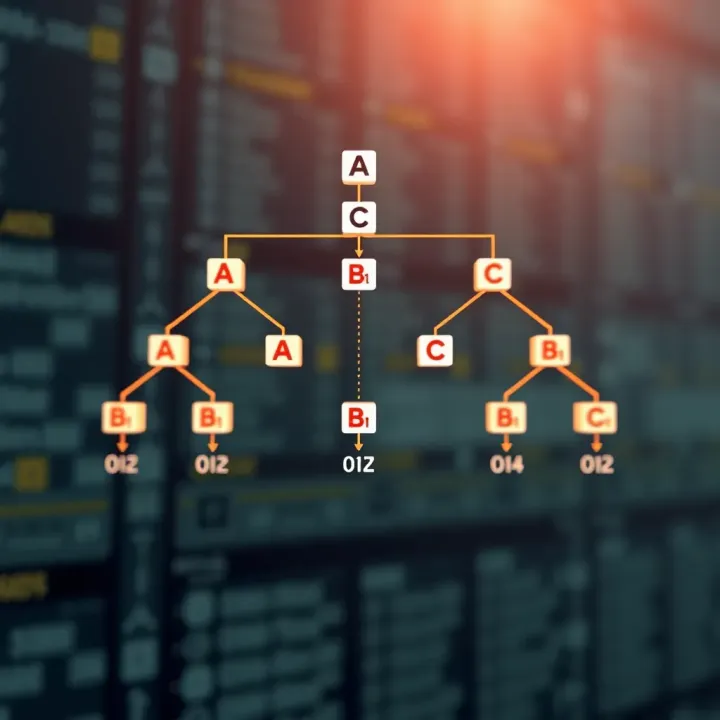
The searching algorithm in a BST exploits the tree's ordered nature. Starting at the root node, it compares the target value with the current node's key. If they match, the search ends successfully. If the target is smaller, the algorithm moves to the left child; if larger, it shifts to the right. This process continues down the tree until the node is found or a null subtree is reached, signalling absence.
This mechanism closely resembles looking for a client’s record in a ledger sorted by account number—rather than scanning every entry, you jump directly to relevant sections. In investment platforms or financial applications, such searching ensures swift client lookup or asset valuation, saving crucial milliseconds.
Time complexity considerations highlight that in a balanced BST, searching requires about log₂n comparisons for n nodes, which means performance scales well even as data grows. However, if the tree becomes skewed, search time can degrade to O(n), similar to a simple linked list scan. This is why maintaining balance matters, particularly where millions of stock transactions or user queries occur.
To insert a node, the process mirrors searching: navigate from the root to the right position following BST order rules, then insert the new node as a leaf. For instance, when adding a new product code to an inventory managed by a fintech app, this method preserves the sorted order without scanning the entire dataset.
Deletion is trickier because there are three cases:
Leaf node: Simply remove it, like deleting a redundant note in your records.
One child node: Remove the node and connect its child directly to the parent, preserving tree integrity.
Two children: Here, replace the node with its in-order successor (smallest in right subtree) or predecessor (largest in left subtree), then delete that successor/predecessor. This ensures the BST property remains intact, preventing data disorganisation.
Managing these cases carefully is vital in systems handling dynamic data entry and removal, like updating customer orders or cancelling trades. A mismanaged deletion could corrupt the search order, causing headaches in data retrieval and slowing operations.
Efficient handling of BST operations like search, insertion, and deletion ensures that your software can scale and handle Nigerian financial or trading data with speed and reliability, even as the dataset grows large or changes frequently.
In summary, these core operations are the backbone of BST usefulness. Grasping their workings, including the impact of tree shape on performance, gives you an edge in developing or analysing Nigerian fintech products, trading platforms, or any data-heavy applications requiring quick access and updates.
Traversal methods in binary search trees (BSTs) are essential for accessing and manipulating the stored data. By visiting nodes in specific orders, BST traversals allow effective retrieval of information, which can be highly useful in real-world applications such as sorting and database querying. For traders, investors, and analysts working with large datasets or financial models, understanding these traversals means faster data operations and more efficient algorithms.
Inorder traversal and its use
Inorder traversal visits nodes in a BST starting from the left subtree, then the parent node, and finally the right subtree. This order ensures data is accessed in ascending sequence because BST property places smaller values to the left and larger values to the right. For example, when a stock price data structure uses a BST, inorder traversal will list all prices from the lowest to the highest.
This makes inorder traversal particularly useful for applications requiring sorted output without the need for extra sorting steps. In finance, this can be valuable when preparing ranked lists, such as ordering securities by market capitalisation or risk ratings automatically through the BST.
Preorder and postorder traversals
Preorder traversal visits the current node first, then moves to its left and right subtrees. This order is practical when the structure itself is important, like when backing up hierarchical data or reconstructing the tree. For example, in portfolio management software, preorder traversal can save the entire decision tree structure for reuse or transfer.
Postorder traversal, on the other hand, visits left and right subtrees before the parent node. This method is often used in cleanup processes or deleting tree nodes because it processes children nodes before parents. For traders designing algorithms that adjust portfolios dynamically, postorder traversal helps in efficiently removing outdated data from a BST without leaving orphan nodes.
Level-order traversal
Level-order traversal accesses nodes level by level from top to bottom, left to right. Unlike inorder or preorder, which are depth-first, level-order walks through the tree breadth-first. This is useful when the application needs to process or display data in order of their depth or prioritise nodes close to the root.
In practical fintech systems, level-order traversal supports tasks like breadth-wise data broadcasting, such as sending alerts or updates to systems arranged hierarchically. It also helps in scenarios where balanced processing of data nodes is required to avoid bottlenecks, for instance, balancing job queues or request handling.
Sorting data using inorder traversal
Because inorder traversal naturally produces a sorted sequence of elements in a BST, it is often used to implement efficient sorting algorithms. Once the data is organized in a BST, simply traversing it inorder outputs a sorted list without additional sorting logic.
This ability reduces computational overhead in trading platforms where price movements or transaction timestamps must be sorted rapidly, like in real-time stock exchange applications or algorithmic trading bots.
Practical uses in programming
Traversals form the backbone of many programming functions involving trees. For instance, preorder traversal assists in copying or serialising data structures, while postorder is essential for deleting or freeing memory in systems with limited resources.
Moreover, level-order traversal is prevalent in scenarios that require breadth-first search logic, such as finding the shortest path or generating reports that summarise different levels of corporate hierarchy or investments. Nigerian software developers often implement these traversals in applications handling user data, real-time analytics, or even Nigerian Stock Exchange (NGX) market feeds.
Traversing BSTs efficiently not only boosts performance but also enhances software scalability, a critical factor for fintech startups competing in Nigeria's dynamic market.
By mastering these traversal techniques, you ensure your data structures remain responsive and suited for diverse real-life demands.
Balancing a binary search tree (BST) ensures that the tree maintains a shape close to perfectly balanced, avoiding skewed forms that can degrade performance. This matters because a balanced BST allows operations like search, insertion, and deletion to happen efficiently, keeping time complexity close to O(log n). For traders, investors, or analysts relying on real-time data access or frequent updates, an unbalanced BST can cause unnecessary delays, especially as data grows.
When a BST becomes unbalanced, its structure starts to resemble a linked list rather than a tree. Imagine a sequence of stock prices inserted in ascending order; the tree ends up with most nodes on one side, slowing down lookups drastically. Instead of quickly zeroing in on a node in a few steps, the search might have to check each node one after the other, increasing time complexity to O(n).
Some signs that your BST needs balancing include noticeable slowdowns in data retrieval or update operations. For instance, if querying your fintech app's customer database takes longer than usual or insertion of new transaction records becomes sluggish, the underlying BST might be skewed. Additionally, if your application returns widely inconsistent response times, it’s a red flag to check the tree structure.
AVL trees maintain balance by keeping the heights of left and right subtrees of any node within one level difference. After each insertion or deletion, the tree performs rotations—simple rearrangements of nodes—to restore balance. For Nigerian startups developing apps where speed matters under high load, AVL trees offer consistently fast operations. This makes them quite handy where data structure performance directly impacts user experience.
Red-Black trees simplify balancing by colouring nodes red or black according to specific rules, ensuring the tree remains approximately balanced without strict height conditions. This often allows easier and faster balancing during insertions and deletions compared to AVL trees. Many programming languages used in Nigeria, like Java or C++, implement Red-Black trees in their standard libraries. Nigerian fintech platforms that adopt these languages can benefit from this robustness, especially when handling large datasets with many concurrent updates.
Balanced BSTs prevent your system from turning into a bottleneck by ensuring data operations run efficiently, a real plus when dealing with fast-moving financial or market data.
By understanding these balancing strategies, Nigerian developers can choose appropriate methods depending on application needs. Balancing BSTs is not just a theoretical concern but a practical step to keep digital systems responsive and reliable.
Binary Search Trees (BSTs) continue to be fundamental in organising data efficiently, easing tasks like searching, inserting, and deleting in software systems. For Nigerian businesses, particularly in fintech and app development, their efficiency can translate directly to better service delivery and customer experience. However, implementing and optimising BSTs locally also demands addressing challenges such as scalability, real-time data processing, and the choice of programming tools suited to Nigeria's tech ecosystem.
Search engines and database indexing depend heavily on structures like BSTs to speed up query responses. In Nigerian software projects that handle sizable datasets – such as e-commerce platforms or government databases – indexing with BSTs ensures quick data retrieval, which is crucial when users expect instant responses. For example, a Nigerian online marketplace handling thousands of product listings benefits from BST-based indexes to sort and search inventory without lag.
Real-world fintech and app development in Nigeria also leverage BSTs for managing users’ transaction histories and real-time analytics. Apps like Paystack or PalmPay incorporate efficient data structures that include BST variants to maintain up-to-date account information and fraud detection. Their ability to swiftly insert and find records in an ordered form allows these platforms to process thousands of transactions per second without bottlenecks.
Programming languages play a vital role in how BSTs are implemented locally. In Nigeria, languages like Python, JavaScript (Node.js), Java, and increasingly TypeScript dominate the scene, thanks to their flexibility and community support. For instance, many startups prototype BST algorithms in Python due to its simplicity, then move to JavaScript or Java for production-level efficiency. Developers need to choose languages that balance speed with ease of maintenance in Nigeria’s business environment.
Besides language choice, handling Nigeria’s data volume and real-time processing demands means BST implementations must scale well. Nigerian fintech apps must operate smoothly during peak business activities, such as ember months or festive sales, when transaction loads spike. Here, optimised BST algorithms combined with proper balancing techniques prevent performance dips. However, developers must also consider underlying infrastructure constraints, like network instability and limited computing resources, which can affect BST operation in Nigerian contexts.
Efficient binary search trees not only improve software responsiveness but also give Nigerian businesses a competitive edge in fast-growing digital markets.
Overall, understanding BST applications and challenges in Nigeria helps tech professionals build more reliable and performant systems tailored to local realities.
🔢 Explore how binary numbers power digital tech in Nigeria! Learn their roles, conversion methods, and everyday applications in simple terms.

📘 Explore the key concepts and examples of binary operations in math and computer science, with tips on how to read them in digital math documents like PDFs.

Explore binary operations in advanced mathematics 🔢 Discover their properties like associativity, identity, and role in groups, rings & fields for deeper learning.

📐Explore binary operations in math & CS: definitions, properties, examples, applications & tips to avoid common mistakes. Build a solid foundation today!
Based on 15 reviews